On 3 and 4 March 2025 European Coordination Via Campesina, Université libre de Bruxelles and the International Institute of Social Studies of Erasmus University Rotterdam organised an international conference in Brussels bringing together researchers and farmers. The aim was to reflect, in a transdisciplinary and interdisciplinary manner, on the lessons to be learned from the successes, failures and setbacks of agricultural market regulation policies in Europe and other parts of the world, both past and present.
The Common Agricultural Policy (CAP) of the European Union (EU) is the subject of intense controversy. However, the uncertainties and risks affecting agricultural production and food supply, both within the EU and globally, pose an ever-greater threat. The security of the European population’s food supply can no longer be taken for granted.
The first part of this report written by Laurence Roudart and Lou Plateau briefly outlines how the CAP has evolved since 1992: the transition from market price support as the primary measure to direct payments and then to decoupled direct payments represented a major turning point. This section then reviews the rationale for public intervention in the agricultural sector as understood within a particular school of public economics. It then discusses decoupled direct payments in comparison to other instruments for supporting farm incomes: market price support, production-coupled payments, area-based payments, payments based on the use of variable inputs, and flat-rate payments based on historical entitlements.
The economic studies referenced in this first section do not provide any sufficiently substantiated arguments in favour of decoupled direct payments over market price support. Some of these studies conclude that production-coupled payments are more effective than decoupled direct payments when positive externalities increase with the level of production. Other studies show that, when combined with quotas, market price support and certain coupled payments can result in outcomes comparable to flat-rate payments. Furthermore, agricultural sociology research suggests that decoupled direct payments have encouraged the development of corporate-style farms managed through delegation rather than by farmers themselves.
The second part of the report provides an overview of agricultural market regulation instruments that can be used to promote agroecological transition, ensure decent incomes for farmers and recreate socio-economic conditions conducive to entering the farming profession. In this context, it is essential to reinstate a policy of supporting the prices paid to farmers for certain products. Such a policy must be linked to supply management mechanisms in order to prevent overproduction, and must be consistent with international trade policies.
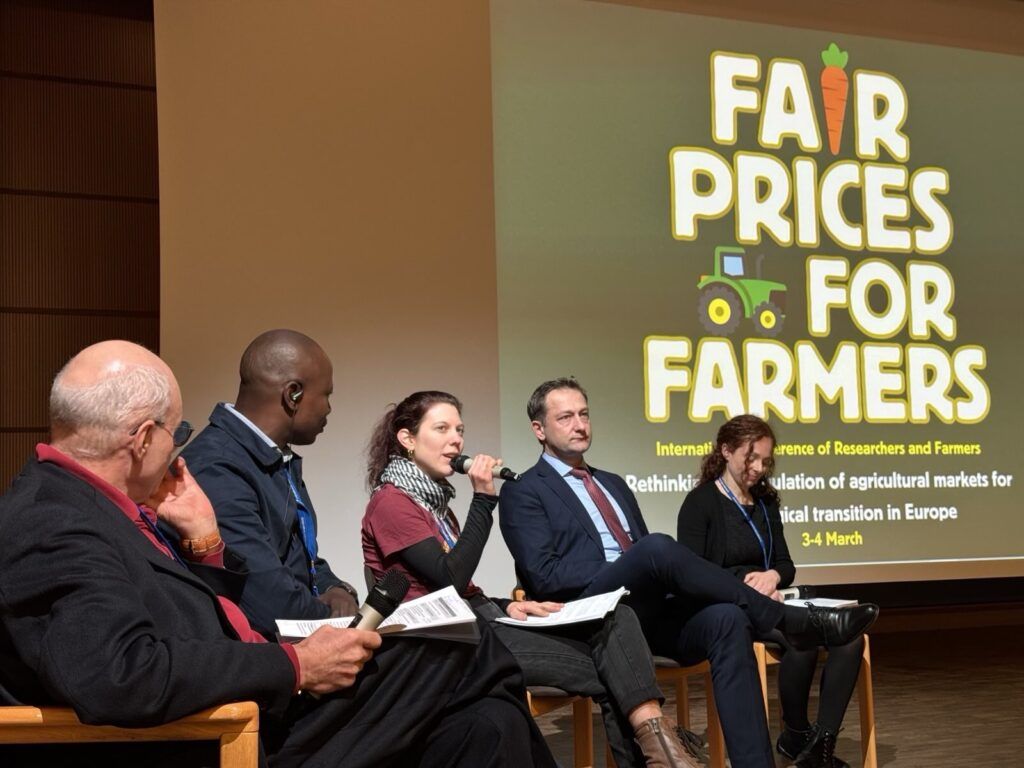
Researchers, farmers from la Via Campesina and ECVC's coordinating committee and Commissioner Hansen discussed how to secure remunerative prices for farmers
The current CAP, which supports agricultural incomes through decoupled payments without explicit guidance, encourages the expansion of large, productivist farms and the continued decline of agriculture. In contrast, the agroecological transition involves developing a network of more numerous and diversified farms distributed across Europe’s agricultural landscapes. To be able to engage in sustainable agricultural practices, which initially involve high risks, farmers must secure prices that cover their production costs. Otherwise, they cannot take these risks.
There are various agricultural policy measures that can be taken to anticipate market imbalances and minimize the risk of future crises arising. It is important that they are implemented in collaboration with producer organisations, at multiple levels of intervention. Such policies are currently operational in many countries, including India, Canada and Norway. Empirical analyses of guaranteed price systems covering milk production costs combined with supply management show that these policies do not necessarily lead to higher costs for consumers. In fact, market deregulation can lead downstream actors in supply chains to increase their profit margins, to the detriment of both producers and consumers.
Neoliberalism is dead. We are facing a severe ecological crisis. Given the new global geopolitical and environmental context, it is vital that we reform the CAP for 2027-34, reverse the decline in the number of farmers, and move towards diversified and sustainable forms of agriculture.
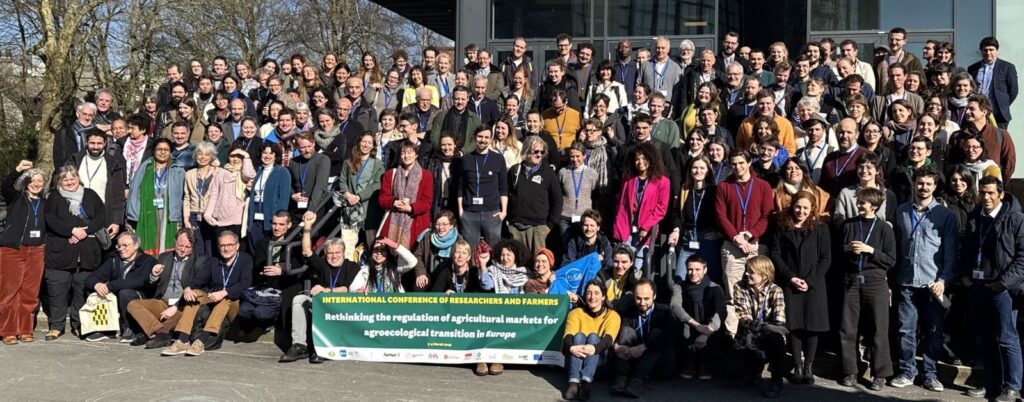
Participants of the conference, bringing together 150+ researchers and farmers internationally